Crypto Funding Rate Arbitrage
Delta-Neutral Passive Income Guide
Harvest consistent hourly yields from market volatility with zero directional exposure. Learn how our automated, multi-exchange execution algorithms execute spot-futures carry trades while securing maximum trading fee cashbacks.
What is Funding Rate Arbitrage?
What is Crypto Funding Rate Arbitrage?
In the cryptocurrency market, **perpetual futures contracts** are the most widely traded instruments. Unlike traditional futures, perpetual contracts do not have an expiry date. To ensure that the price of the perpetual contract closely tracks the spot market index price, exchanges utilize a built-in mechanism called the Funding Rate.
Every 8 hours (or hourly on specific volatile tokens), traders holding long or short positions pay or receive funding fees. If market sentiment is highly bullish, long traders pay shorts a percentage of their position size. If sentiment is extremely bearish, shorts pay longs.
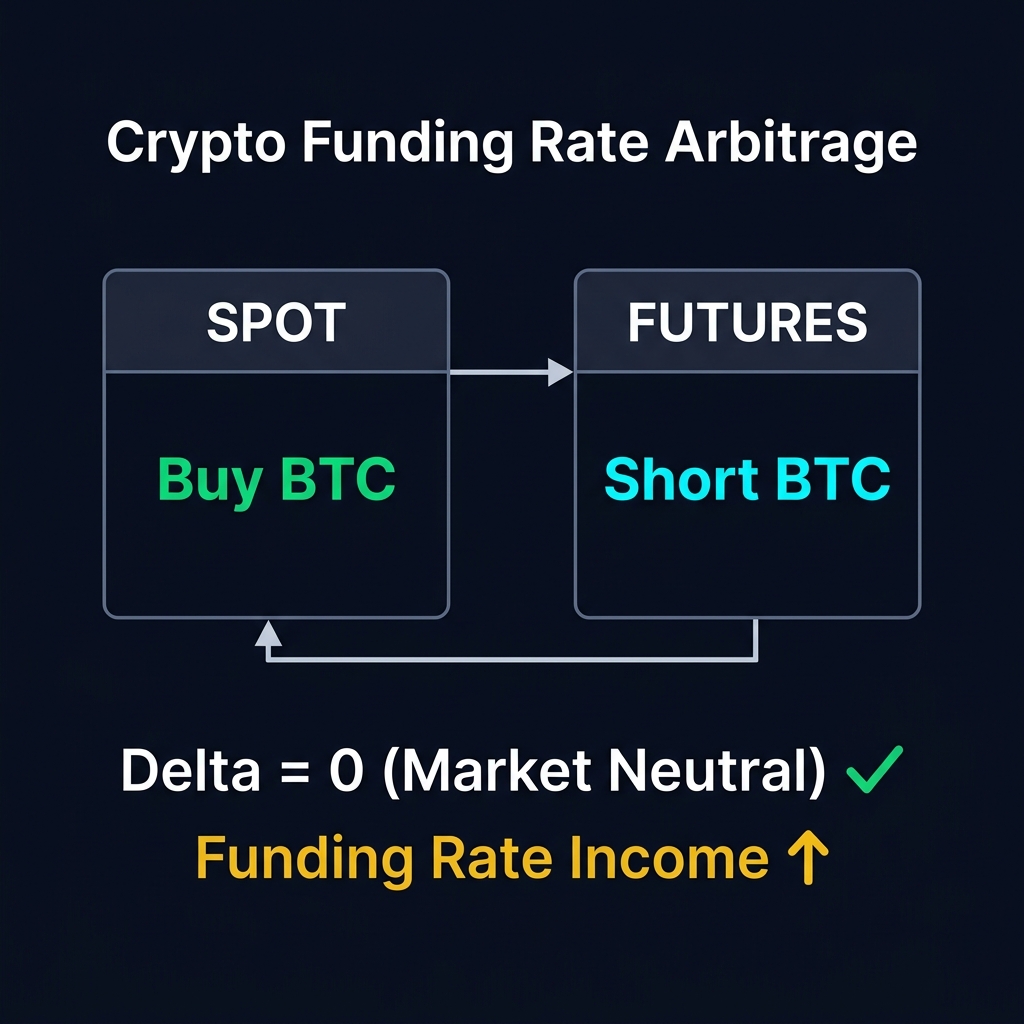
Funding Rate Arbitrage (also known as a cash-and-carry trade) is a market-neutral investment strategy designed to exploit these payouts. By buying an asset on the spot market and simultaneously opening an equal-sized short position in the perpetual futures market, you capture these funding rate payouts while sheltering your capital from price swings.
- Collect yields up to 3 times daily (every 8 hours)
- Zero market exposure - insulated from Bitcoin crashes
- Highly predictable cash flow in bullish markets
Why Delta-Neutral Trading has Zero Directional Risk
Understanding the mathematical hedge that insulates your capital from crypto volatility.
In financial engineering, Delta (Δ) represents the sensitivity of a portfolio's value to changes in the price of the underlying asset. A standard spot long position has a Delta of +1.0, meaning its value moves 1:1 with the market. A futures short position has a Delta of -1.0, meaning its value moves inversely 1:1 with the market.
When you open a hedged carry trade:
Portfolio Delta = (Spot Delta: +1.0) + (Futures Delta: -1.0) = 0.0 Delta (Market Neutral)
Whether Ethereum rises to $10,000 or plunges to $100, the dollar value of your hedged position remains stable. Since the market price component is mathematically zeroed out, you are left with one primary variable: the Funding Rate income.
Automated execution software monitors basis deviation, rebalances futures collateral (preventing liquidation on extreme upward spikes), and captures funding fees smoothly without requiring manual oversight.
Step-by-Step Execution Mechanics
How the automated arbitrage system opens, manages, and compounds trades.
Pair Selection & Filtering
The scanner tracks 150+ tokens on multiple spot-futures pairs. It filters out low-liquidity coins and ranks markets by their running 3-day, 7-day, and 30-day average funding yield rates to select high-yield options.
Hedged Smart Execution
To avoid slippage, the execution engine places a limit buy order on Spot and an algorithmic taker short on Futures. The orders are matched down to the millisecond, locking in the basis delta instantly.
Margin Stabilization
If the token price surges, the system automatically pulls margins from spot balances and transfers them to the futures account to prevent short-side liquidation, ensuring continuous, bulletproof uptime.
How Exchange Trading Fees and Rebates affect Yields
The absolute silent killer of arbitrage returns is fee drag. Because an arbitrage trade requires buying spot, shorting futures, and eventually unwinding both positions, you execute a minimum of 4 individual transactions.
If your exchange fee tier is 0.1% per trade, you will lose a staggering 0.4% of your total capital just in transactional costs. In standard market conditions, this completely wipes out the first 2-3 weeks of funding rate profits.
This is where TraderRebate becomes your critical edge. By registering your exchange accounts through our hand-curated rebate links, you receive up to a 30% direct cash refund on every trade fee. This lowers your transactional cost floor, turning marginal funding opportunities into high-frequency yield engines.
Frequently Asked Questions
Everything you need to know about delta-neutral cash-and-carry crypto setups.